
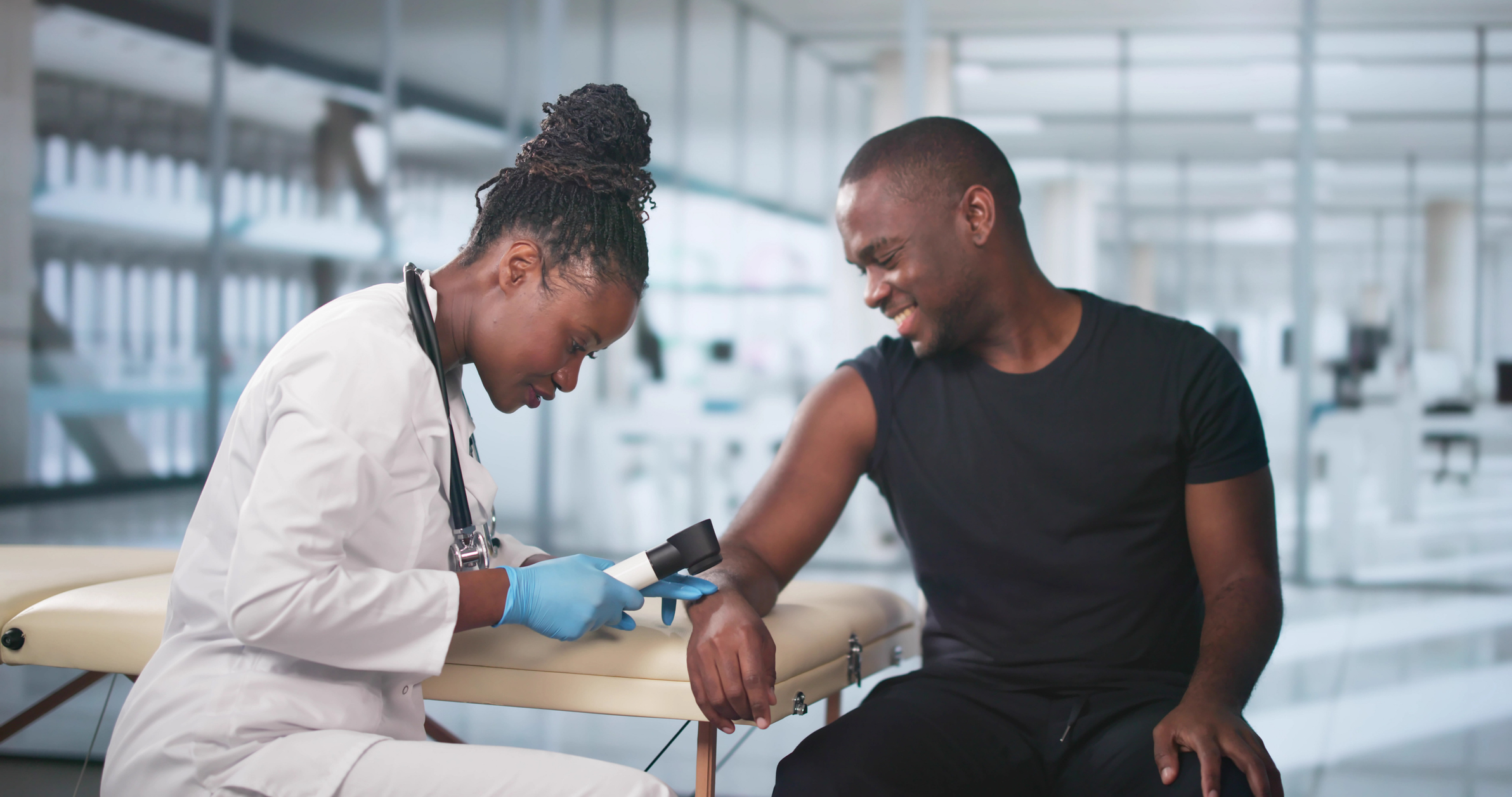
Skin Cancer
Skin cancer is the most common cancer in the United States — and most types are highly curable. Mission Oncology Partners treats skin cancer with radiation therapy and brachytherapy, on its own or alongside surgery.
About skin cancer
Your skin is the body's largest organ and its most exposed. It protects everything underneath it from damage and the elements, and it takes ultraviolet rays from the sun every day. That exposure is what puts us at risk.
According to the American Cancer Society, more than one million cases of basal and squamous cell skin cancers and 73,870 cases of melanoma will be diagnosed in the United States this year, making skin cancer the most common cancer. At its current rate, one in every five people will be diagnosed with some type of skin cancer in their lifetime.
Skin cancer comes in several forms. Basal cell carcinoma is the most common and is very curable; it begins in the outer layer of skin and rarely spreads elsewhere. Squamous cell carcinoma is the second most common and also begins in that outer layer. Melanoma is less common but the most serious, beginning in the cells that produce skin color. Merkel cell carcinoma is rare and develops between the two main layers of skin.
Signs and symptoms
Skin cancers look different depending on the type and where they develop. Anything on your skin that is new, changing or not healing deserves a look.
- A sore or spot that does not heal
- A mole or freckle that changes in size, shape or color
- A new growth on skin that gets regular sun exposure
- A patch of skin that is scaly, rough or persistently irritated
- A firm, painless lump under the skin's surface
When to call
These symptoms have many possible causes, most of them not cancer. But they are worth a conversation. If something has changed and hasn't resolved, contact your primary care physician — early evaluation is what makes treatment straightforward.
How we treat it
Which treatment you receive depends on several things: your overall health, the stage of the disease and whether the cancer has spread. After an initial examination, your physician builds a personalized plan and walks you through the options. For some squamous cell cancers and melanomas, your physician will also check whether the cancer has reached the lymph nodes. Radiation therapy, brachytherapy, surgery and chemotherapy may be used alone or in combination.
External beam radiation therapy
Radiation oncologists use advanced machines that deliver high-energy particles or waves — X-rays, gamma rays or electron beams — to target cancer cells and alter their DNA so they die off. The beam is aimed only at the region holding the cancer, which reduces how many healthy cells are affected. Some healthy cells are hit, but they are able to repair themselves over time.
High-dose-rate (HDR) brachytherapy
Brachytherapy places the radiation source very close to the skin cancer rather than directing it from a distance. It can be applied with metal applicators, a series of tubes, or a flap of beads that conforms to the shape of the skin. When HDR treatments are given, sessions are usually scheduled two days a week instead of every day.
Radiation with or without surgery
Radiation therapy can be used to treat squamous cell cancers that start on the skin, and sometimes nearby lymph nodes, either on its own or together with surgery. Your physician will tell you which sequence fits your case — and why.
What treatment involves
A typical radiation therapy session is completely painless and lasts only a few minutes. Most of your appointment is setup; the treatment itself is brief.
If your plan uses HDR brachytherapy, treatments are usually given two days a week rather than daily. Long-term studies following patients treated this way show it is very effective for skin cancer, with the vast majority remaining cancer free many years afterward. The cosmetic outcome with HDR brachytherapy is generally excellent and recovery time is minimal.
Possible side effects
Side effects are usually temporary and typically resolve shortly after treatment ends. Tell your care team about any discomfort — managing it is part of the treatment, not an interruption to it.
- Redness, dryness or irritation of the skin in the treated area
- Tiredness during the course of treatment
- Sensitivity in the treated area, which is why we ask you to stay out of the sun
- Side effects vary with the part of the body being treated, the dose given and whether you are also receiving chemotherapy
Caring for yourself during treatment
- Rest when you need to, and don't hesitate to ask for help.
- Follow your care team's advice — and ask when anything is unclear.
- Tell us about every medication, vitamin and supplement you take.
- Eat a balanced diet and drink plenty of fluids.
- Treat skin in the treatment area gently: no sun, no hot or cold packs, and only lotions your team has approved.
- Lean on support groups, family and friends. Coping is part of treatment.
Trusted resources
- Melanoma International Foundation — www.safefromthesun.org
- Melanoma Research Foundation — www.melanoma.org
- Skin Cancer Foundation — www.skincancer.org
- RT Answers (patient brochures) — www.rtanswers.org
Clinical background adapted from materials by the American Society for Radiation Oncology (rtanswers.org) and the American Cancer Society.
Cancers We Treat
Talk to a Physician
Most new patients are seen within a few days of referral. Bring your questions — we'll make time for them.
Request an appointmentDiagnosed with skin cancer?
Talk with a board-certified radiation oncologist about whether radiation therapy belongs in your treatment plan.