
Pancreatic Cancer
Radiation is rarely used alone for pancreatic cancer. It works alongside chemotherapy and surgery, and our job is to make that combination as effective and as tolerable as we can.
About pancreatic cancer
The pancreas sits deep in the abdomen, behind the stomach and in front of the spine. It makes enzymes that help you digest food and hormones that control blood sugar. Most pancreatic cancers begin in the ducts that carry those enzymes, and are called adenocarcinomas. A smaller group, neuroendocrine tumors, behave differently and are treated differently.
Because the pancreas is surrounded by major blood vessels, the stomach, the small bowel and the bile duct, the key question is not only how far the cancer has spread but how it sits against those structures. Your team will describe your tumor as resectable, borderline resectable, locally advanced or metastatic. That description drives everything that follows, including whether radiation is part of your plan and when.
Radiation is almost always given together with or after chemotherapy. It may be used before an operation to shrink a tumor away from a blood vessel and improve the chance of a clean removal, after an operation when the margin was close, or on its own when surgery is not possible, to slow local growth and relieve symptoms such as back pain.
Signs and symptoms
Pancreatic cancer can be quiet for a long time, and the symptoms it does cause are easy to mistake for something ordinary.
- Yellowing of the skin or the whites of the eyes, called jaundice
- Dark urine, pale or greasy stools, or itchy skin
- A dull ache in the upper abdomen that goes through to the back
- Losing weight without trying
- Poor appetite, or feeling full quickly
- Nausea, indigestion or a change in how food is digested
- New diabetes, or blood sugar that suddenly becomes harder to control
- Unusual tiredness
- A blood clot in a leg or lung, with no obvious cause
When to call
These symptoms have many possible causes, most of them not cancer. But they are worth a conversation. If something has changed and hasn't resolved, contact your primary care physician — early evaluation is what makes treatment straightforward.
How we treat it
Pancreatic cancer is treated by a team. A surgical oncologist, a medical oncologist, a gastroenterologist and your radiation oncologist look at the same scans and agree on a sequence. Chemotherapy usually starts first. Radiation is added when it can improve local control — to make an operation more likely to succeed, to reduce the chance of the cancer returning in the same place, or to keep a tumor from growing into nearby nerves and causing pain. We plan around the stomach and small bowel with a great deal of care, since they sit within millimeters of the target.
Stereotactic body radiation therapy (SBRT)
SBRT delivers a high dose to a tightly defined target in about five sessions. For pancreatic cancer we use it most often for locally advanced tumors that cannot be removed, and sometimes before surgery for borderline resectable disease. The short course fits neatly between cycles of chemotherapy, which is one of its practical advantages. It requires very accurate targeting, so it is paired with motion management and daily imaging.
Intensity-modulated radiation therapy (IMRT)
IMRT breaks the beam into many small segments of varying intensity, so the dose can be shaped around the tumor while curving away from the stomach, duodenum, kidneys and spinal cord. It is our usual choice for chemoradiation, where a lower daily dose is given over about five to six weeks together with chemotherapy, and for treatment after surgery.
Volumetric modulated arc therapy (VMAT)
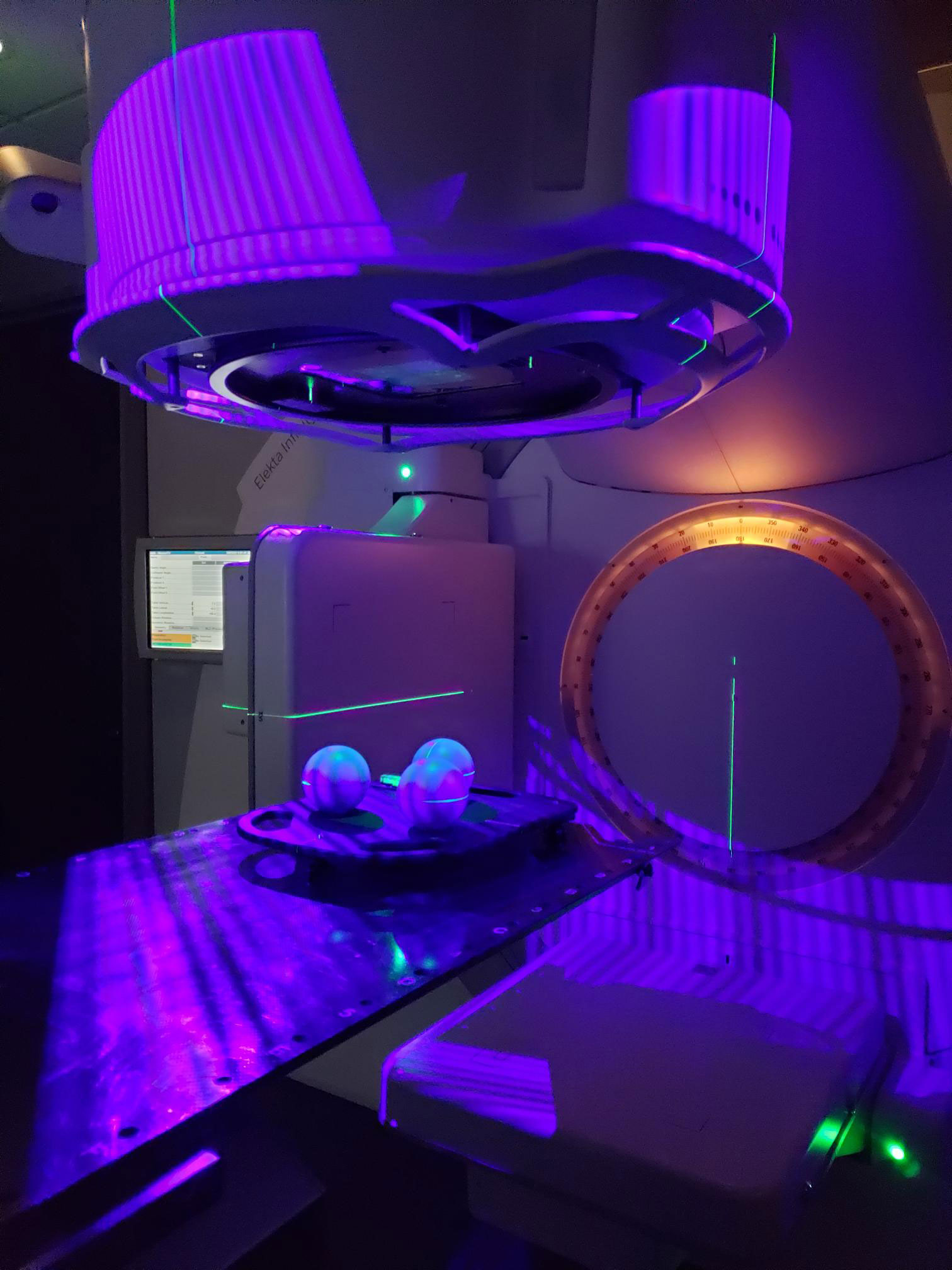
VMAT is a way of delivering IMRT in which the machine rotates around you while the beam shape and dose rate change continuously. It produces the same conformal dose in a fraction of the time, which means less time on the table and less chance of movement during treatment. Most of our IMRT plans for the abdomen are delivered this way.
Image-guided radiation therapy (IGRT)
IGRT is the daily imaging that confirms where the tumor and the nearby bowel are before the beam turns on. Because the pancreas moves with breathing and digestion, this step matters more here than almost anywhere else. Some patients have small gold fiducial markers placed near the tumor beforehand, often during an endoscopic ultrasound, to give us a precise target on those images.
Palliative radiation
When the aim is relief rather than cure, a short course of external beam radiation can ease the back pain caused by a tumor pressing on nerves, control bleeding, or reduce pressure on the bile duct or stomach outlet. These courses are usually one to two weeks and are designed to be easy to get through.
What treatment involves
You start with a simulation, a planning session that takes about an hour. We scan you on a CT in the position you will be treated in, usually on your back with your arms above your head and a cushion shaped to hold you steady. You will likely be asked not to eat for a few hours beforehand, so that your stomach is the same size every day. If breathing motion is significant, we will practice a breath-hold technique with you or set up motion tracking. Small skin marks let us line you up the same way each visit.
If fiducial markers are part of the plan, they are placed in a short endoscopic procedure before simulation. Your radiation oncologist and a medical physicist then build and verify your plan, which typically takes about a week.
A chemoradiation course runs Monday through Friday for roughly five to six weeks, with each visit lasting about 20 to 30 minutes. An SBRT course is about five treatments over one to two weeks, with somewhat longer visits because of the extra imaging and breath-hold work. The beam itself is on for only a few minutes and you feel nothing while it runs. You are not radioactive at any point, and most people drive themselves to and from treatment.
Possible side effects
Side effects are usually temporary and typically resolve shortly after treatment ends. Tell your care team about any discomfort — managing it is part of the treatment, not an interruption to it.
- Nausea, sometimes with vomiting — we prescribe medication ahead of time to prevent it
- Loss of appetite and difficulty keeping weight on
- Tiredness that builds over the course
- Loose stools or diarrhea
- Heartburn or stomach irritation
- Lower blood counts, particularly when chemotherapy is given at the same time
- Changes in blood sugar
- Mild redness or dryness of the skin over the treated area
Caring for yourself during treatment
- Rest when you need to, and don't hesitate to ask for help.
- Follow your care team's advice — and ask when anything is unclear.
- Tell us about every medication, vitamin and supplement you take.
- Eat a balanced diet and drink plenty of fluids.
- Treat skin in the treatment area gently: no sun, no hot or cold packs, and only lotions your team has approved.
- Lean on support groups, family and friends. Coping is part of treatment.
Trusted resources
- Pancreatic Cancer Action Network — 1-877-272-6226
- Lustgarten Foundation — www.lustgarten.org
- American Cancer Society — 1-800-227-2345
- National Cancer Institute — 1-800-422-6237
- RT Answers, American Society for Radiation Oncology — www.rtanswers.org
Clinical background adapted from materials by the American Society for Radiation Oncology (rtanswers.org) and the American Cancer Society.
Cancers We Treat
Talk to a Physician
Most new patients are seen within a few days of referral. Bring your questions — we'll make time for them.
Request an appointmentDiagnosed with pancreatic cancer?
Talk with a board-certified radiation oncologist about whether radiation therapy belongs in your treatment plan.