
Stomach Cancer
For stomach cancer, radiation is usually paired with chemotherapy and timed around surgery. The aim is to lower the chance the cancer comes back where it started.
About stomach cancer
Stomach cancer, also called gastric cancer, most often begins in the cells that line the inside of the stomach. Tumors near the top of the stomach, where it meets the esophagus, are called gastroesophageal junction cancers and are treated much like esophageal cancer. Tumors lower down in the body of the stomach are treated as gastric cancer. Where the tumor sits changes the plan, so your team will be specific about it.
Several things raise the risk, including long-term infection with Helicobacter pylori, smoking, chronic inflammation of the stomach lining, a diet heavy in salted or smoked foods, and a family history of the disease. Some of these are treatable in their own right, and your physician may address them alongside cancer treatment.
Surgery is the main treatment when the cancer can be removed. Chemotherapy is nearly always part of the plan. Radiation is added in specific situations: before surgery together with chemotherapy to shrink the tumor and make a complete removal more likely, or after surgery when the margins were close, lymph nodes were involved, or chemotherapy alone is not considered enough. It is also used on its own to relieve symptoms when surgery is not an option.
Signs and symptoms
Early stomach cancer often feels like indigestion, which is why symptoms that persist are worth checking.
- Heartburn or indigestion that does not go away or does not respond to usual remedies
- Feeling full after eating only a small amount
- Discomfort, pain or a bloated feeling in the upper abdomen
- Nausea or vomiting
- Vomiting blood, or stools that look black and tarry
- Trouble swallowing, especially with tumors near the top of the stomach
- Losing weight without trying, or losing your appetite
- Tiredness or shortness of breath from a low blood count
When to call
These symptoms have many possible causes, most of them not cancer. But they are worth a conversation. If something has changed and hasn't resolved, contact your primary care physician — early evaluation is what makes treatment straightforward.
How we treat it
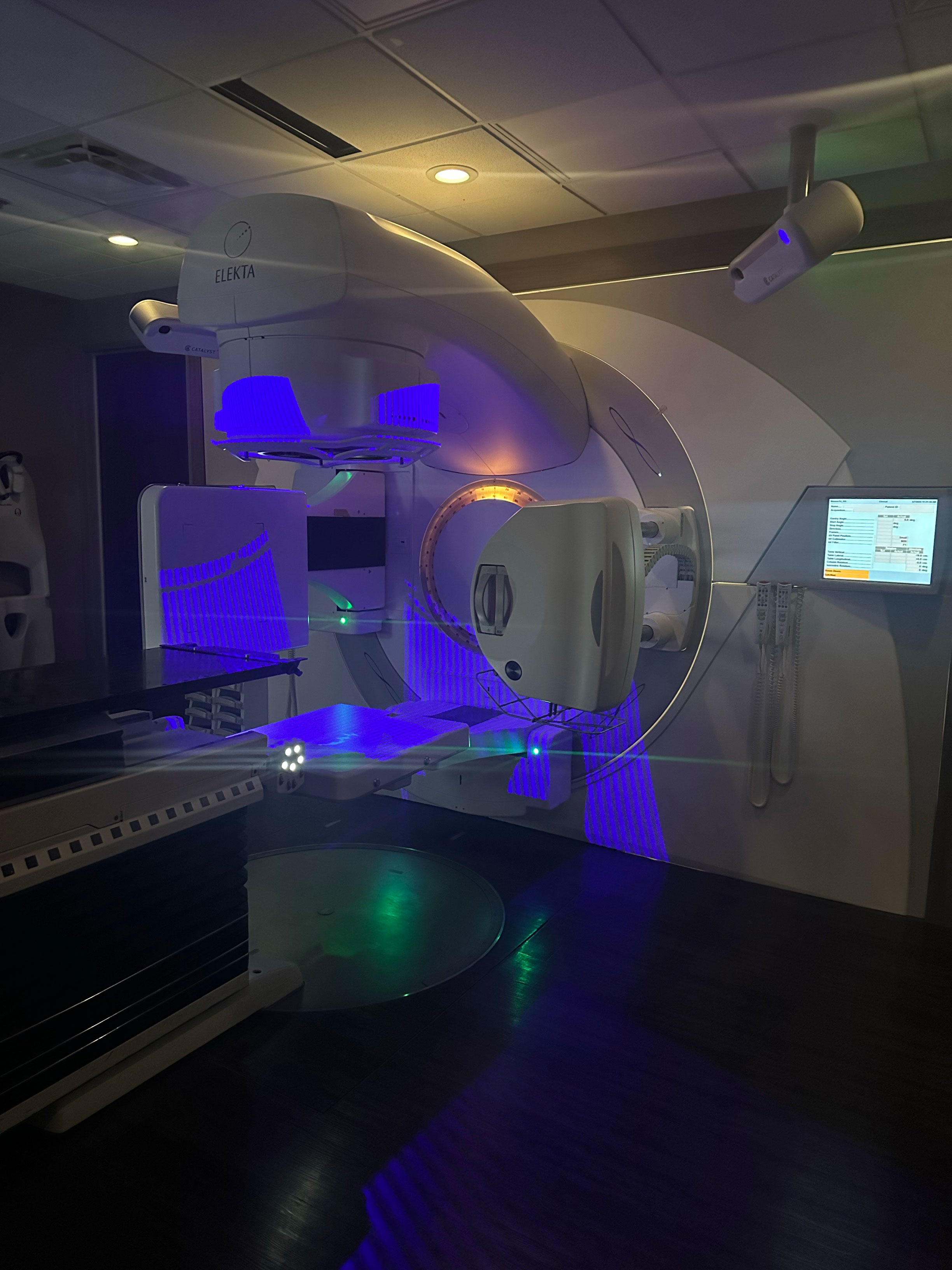
Your plan is put together by a surgeon, a medical oncologist and your radiation oncologist working from the same imaging and pathology. When radiation is used, it is nearly always given at the same time as a low dose of chemotherapy, which makes the radiation work better. The stomach sits close to the liver, kidneys, spinal cord, heart and small bowel, and it changes shape depending on how full it is, so precision and consistency matter. We will give you clear instructions about eating before treatment for exactly that reason.
Intensity-modulated radiation therapy (IMRT)
IMRT divides the beam into many small segments of different intensity so the dose conforms closely to the treatment area while curving away from the kidneys, liver, spinal cord and heart. It is our standard approach for stomach cancer, whether radiation is given before surgery or afterward, and it is a large part of why treatment is better tolerated than it once was.
Volumetric modulated arc therapy (VMAT)
VMAT delivers an IMRT plan while the machine rotates around you, adjusting the beam shape and dose rate continuously. The result is the same carefully shaped dose in a much shorter session, often two to three minutes of beam time. Less time on the table means less chance of shifting position partway through.
Image-guided radiation therapy (IGRT)
Before each treatment we take an image on the table and compare it with your plan, then make small adjustments to your position. This matters in the upper abdomen because the stomach and diaphragm move with breathing and with digestion. IGRT is how we keep the dose where it belongs day after day.
Three-dimensional conformal radiation therapy (3D-CRT)
3D-CRT builds a treatment plan from a CT model of your anatomy and shapes several beams to match the outline of the target. It is a well-proven approach, and it is a good choice when a simpler plan will do the job just as well, or when a straightforward setup is easier for a patient to manage.
Palliative radiation
When surgery is not possible, a short course of external beam radiation can control bleeding from a tumor, relieve pain, or reduce a blockage that is making it hard to eat. Courses are usually one to two weeks, and the goal is to help you feel better and eat more comfortably.
What treatment involves
Treatment begins with a simulation, a planning appointment of about 45 minutes to an hour. You lie on your back on a CT scanner, usually with your arms above your head in a cushion or cradle made to fit you. We may use contrast, and we will ask you to come with an empty stomach so that your anatomy looks the same each day. A few small skin marks are placed so the therapists can line you up precisely at every visit.
Your radiation oncologist and a medical physicist then design and check your plan, which normally takes about a week. Chemotherapy scheduling is coordinated with your medical oncologist so the two treatments line up properly.
A typical course is daily treatment Monday through Friday for about five weeks, roughly 25 sessions, with weekends off. Each visit takes about 15 to 30 minutes, and only a few of those minutes are actual treatment. You will see your radiation oncologist at least once a week during the course so we can stay ahead of any side effects. Radiation is painless, you are not radioactive, and most people continue to drive themselves and keep working at least part time.
Possible side effects
Side effects are usually temporary and typically resolve shortly after treatment ends. Tell your care team about any discomfort — managing it is part of the treatment, not an interruption to it.
- Nausea, and sometimes vomiting — we prescribe medication in advance to prevent it
- Loss of appetite and weight loss
- Tiredness that builds through the course
- Heartburn or stomach irritation
- Loose stools or diarrhea
- Lower blood counts when chemotherapy is given at the same time
- Mild redness or dryness of the skin over the treated area
- Changes in how food tastes
Caring for yourself during treatment
- Rest when you need to, and don't hesitate to ask for help.
- Follow your care team's advice — and ask when anything is unclear.
- Tell us about every medication, vitamin and supplement you take.
- Eat a balanced diet and drink plenty of fluids.
- Treat skin in the treatment area gently: no sun, no hot or cold packs, and only lotions your team has approved.
- Lean on support groups, family and friends. Coping is part of treatment.
Trusted resources
- Debbie's Dream Foundation, Curing Stomach Cancer — www.debbiesdream.org
- Gastric Cancer Foundation — www.gastriccancer.org
- American Cancer Society — 1-800-227-2345
- National Cancer Institute — 1-800-422-6237
- RT Answers, American Society for Radiation Oncology — www.rtanswers.org
Clinical background adapted from materials by the American Society for Radiation Oncology (rtanswers.org) and the American Cancer Society.
Cancers We Treat
Talk to a Physician
Most new patients are seen within a few days of referral. Bring your questions — we'll make time for them.
Request an appointmentDiagnosed with stomach cancer?
Talk with a board-certified radiation oncologist about whether radiation therapy belongs in your treatment plan.