
Liver Cancer
We can treat a liver tumor precisely without an incision. For many people that means a few short sessions, delivered with millimeter accuracy, and no hospital stay.
About liver cancer
Primary liver cancer starts in the liver. The most common form is hepatocellular carcinoma, which usually develops in a liver already scarred by cirrhosis — from hepatitis B or C, years of heavy alcohol use, or fatty liver disease. A less common form, intrahepatic cholangiocarcinoma, begins in the bile ducts inside the liver. Because so many people with liver cancer also have liver disease, protecting the healthy part of the liver matters as much as treating the tumor.
The liver is also one of the most common places for cancer to spread from somewhere else, particularly from the colon, rectum, breast, lung or pancreas. Those tumors are treated as metastatic disease from the original cancer, though the radiation techniques we use are often the same.
Two things make the liver a demanding target. Healthy liver tissue is sensitive to radiation, and the liver moves with every breath. We plan around both. Careful dose shaping, breathing management and imaging on the table let us put a high dose into the tumor and keep it off the rest of the liver, the stomach and the bowel.
Signs and symptoms
Liver cancer often causes nothing at all early on, and is sometimes found on a scan ordered for another reason. When symptoms do appear, they can include:
- Pain, aching or a feeling of fullness in the upper right side of the abdomen
- A firm lump or swelling just below the ribs on the right
- Yellowing of the skin or the whites of the eyes, called jaundice
- Dark urine or pale stools
- Losing weight without trying, or losing your appetite
- Feeling full after only a small amount of food
- Nausea or vomiting
- Swelling in the abdomen or the legs
- Itchy skin
- Unusual weakness or tiredness
When to call
These symptoms have many possible causes, most of them not cancer. But they are worth a conversation. If something has changed and hasn't resolved, contact your primary care physician — early evaluation is what makes treatment straightforward.
How we treat it
Liver cancer is a team decision. Your care may involve a hepatologist, a surgeon, an interventional radiologist and a medical oncologist alongside your radiation oncologist. Surgery or a liver transplant is the first choice when it is possible. When it is not — because of where the tumor sits, how the liver is functioning, or other health conditions — radiation becomes a strong option. We also use it to hold a tumor steady while someone waits for a transplant, and to treat tumors that have come back after ablation or embolization.
Stereotactic body radiation therapy (SBRT)
SBRT is our headline technique for liver tumors. It delivers a high, tightly focused dose in just three to five sessions, with the dose falling off sharply at the edge of the target so the surrounding liver is spared. We use it for tumors that cannot be removed surgically, for people who are not candidates for an operation, for tumors in spots that are hard to reach with ablation, and as a bridge to transplant. There is no incision and no anesthesia.
Image-guided radiation therapy (IGRT)
IGRT means we image you on the treatment table immediately before each session and adjust your position to the millimeter. For the liver this is essential. Sometimes a gastroenterologist or interventional radiologist places tiny gold markers called fiducials in or near the tumor beforehand, which give us a clear target on the daily images. We combine this with breath-hold or motion tracking so the tumor is in the same place every time the beam is on.
Intensity-modulated radiation therapy (IMRT) and VMAT
IMRT shapes the beam into a dose that conforms closely to an irregular tumor. VMAT delivers that shaped dose while the machine rotates around you, which shortens each session. We choose these for larger tumors, for tumors sitting close to the stomach or bowel, and for people whose liver function means the dose needs to be spread over more, smaller treatments.
Palliative radiation
When the goal is comfort rather than cure, a short course of external beam radiation can relieve pain from a tumor stretching the liver capsule, ease pressure symptoms, or control bleeding. These courses are usually one to ten sessions, and they are planned to be as easy as possible to get through.
What treatment involves
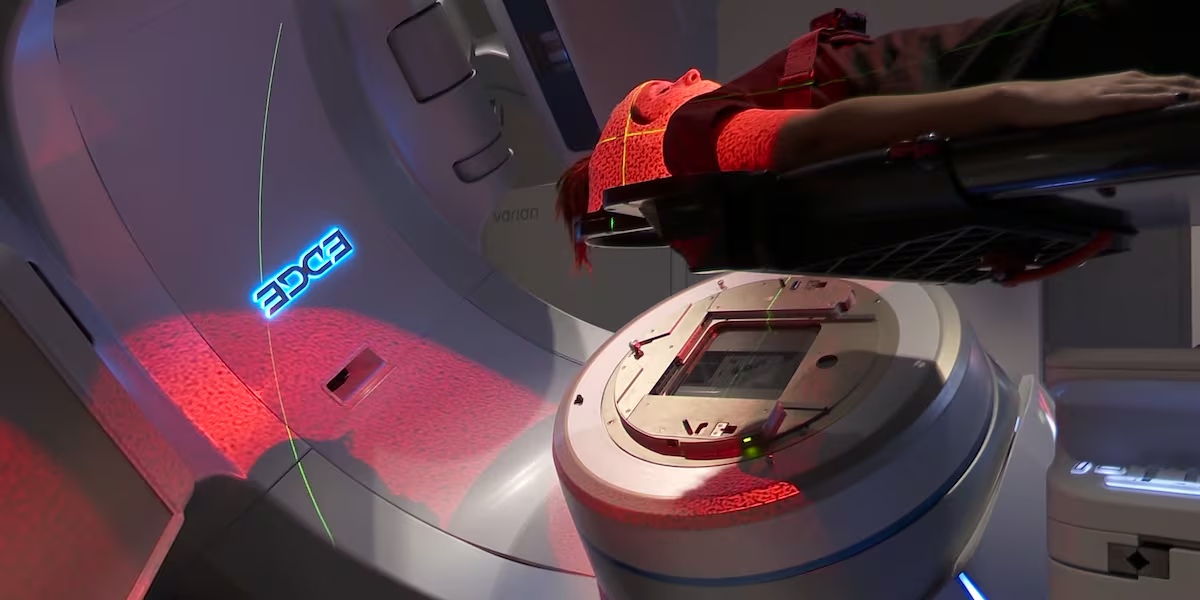
Treatment starts with a simulation, a planning appointment that takes about an hour. You lie on your back on a CT scanner, usually in a cushion molded to your shape, with your arms above your head. We may use IV contrast so the tumor shows clearly. Because the liver moves when you breathe, we will practice a breathing technique with you — often a comfortable breath hold, or a device that tracks your breathing so the beam only fires at the right moment. We place small skin marks for daily alignment.
If fiducial markers are part of your plan, they are placed in a separate short procedure before simulation, and we allow a few days for any swelling to settle. Your plan is then built and checked by your radiation oncologist and a medical physicist, which usually takes about a week.
An SBRT course is typically three to five treatments given over one to two weeks, sometimes every other day rather than daily. Plan on 30 to 45 minutes in the department for each visit, most of it spent on positioning and imaging; the beam itself runs for only a few minutes. An IMRT or VMAT course is longer, often two to six weeks of daily treatment Monday through Friday, with shorter visits. Radiation is painless, you are not radioactive afterward, and you can drive yourself home.
Possible side effects
Side effects are usually temporary and typically resolve shortly after treatment ends. Tell your care team about any discomfort — managing it is part of the treatment, not an interruption to it.
- Tiredness, which usually builds gradually and fades over the weeks after treatment
- Nausea or a smaller appetite
- Mild soreness or aching under the ribs on the right
- Indigestion or stomach irritation if the stomach sits near the treated area
- Changes in liver blood tests, which we monitor throughout
- Mild redness or dryness of the skin over the treatment area
- In people with significant cirrhosis, a temporary decline in liver function — a risk we weigh carefully before recommending treatment
Caring for yourself during treatment
- Rest when you need to, and don't hesitate to ask for help.
- Follow your care team's advice — and ask when anything is unclear.
- Tell us about every medication, vitamin and supplement you take.
- Eat a balanced diet and drink plenty of fluids.
- Treat skin in the treatment area gently: no sun, no hot or cold packs, and only lotions your team has approved.
- Lean on support groups, family and friends. Coping is part of treatment.
Trusted resources
- American Liver Foundation — 1-800-465-4837
- American Cancer Society — 1-800-227-2345
- National Cancer Institute — 1-800-422-6237
- Cholangiocarcinoma Foundation — www.cholangiocarcinoma.org
- RT Answers, American Society for Radiation Oncology — www.rtanswers.org
Clinical background adapted from materials by the American Society for Radiation Oncology (rtanswers.org) and the American Cancer Society.
Cancers We Treat
Talk to a Physician
Most new patients are seen within a few days of referral. Bring your questions — we'll make time for them.
Request an appointmentDiagnosed with liver cancer?
Talk with a board-certified radiation oncologist about whether radiation therapy belongs in your treatment plan.